Friday, December 4, 2015

Current Events, Analysis, and KQED's Do Now

If you're a teacher who would like to use current events in your classroom, I would strongly suggest that you follow KQED's Do Now  for regularly updated resources on different issues that are up for question and in the news.
In the last two years, we've begun to use Do Now as our main current events resource and prompt.   It's a been a great resource to get multimedia and multi-opinion perspectives and analysis on different ongoing issues.  For example in the last couple of years, my students have examined illegal immigration, ethics in journalism, the drought, minimum wage, vaccinations, the Charlie Hebdo attacks, and the Syrian refugee crisis among other issues.  

The attitude we try to take in my classroom is that we need to get to the bottom of the issues and we need to analyze with how or why questions to do that.  However, we often need background and context before we can get to the analysis.
Teaching current events has become so much easier with the greater proliferation of internet access in the classroom.  I teach at Minarets High School in the foothills of the Sierra Nevada between Yosemite and Fresno and our students are 1:1 with laptops.  However, even without every student having a computer, the internet has allowed me to bring the world into my classroom.  One of the best examples was the Arab Spring.  I was teaching at a continuation school in Mariposa County and we had a great time learning about the different issues that were coming to play in downtown Cairo, which could not have been farther from rural California and, none of my students had a laptop.  We printed articles from the internet and watched video reports on the big screen and were able to analyze what was going on in real time.
Another great example, which will illustrate how we currently use current events and Do Now, was the recent attacks in Paris.  The attacks occurred on a Friday afternoon for us on the West Coast which meant I had the weekend to gather resources for my students to understand what had happened.  I created a Google Doc on the Paris Attacks with links to resources and guiding analytical questions regarding the attacks.  I modeled the resources on those KQED uses on their Do Now's and I added my usual guiding analytical questions.


I put the link on the class blog and we watched the videos together and answered the questions as a group with all the students putting their answers in their own words:
As you can see, the Paris Attacks Google Doc was in the blog and the students were able to access the resources and the guiding questions.  With the Paris Attacks, I knew most of my students knew very little about ISIS and Syria, but that they had some background with the war in Iraq.  All of this meant that we had to begin with summary types of questions, the who, what, where, and when.  From there we could move into deeper analysis and get into the hows and whys of terrorism and ISIS.  
I always try to make what we study as personal as possible.  I did this with the Paris attacks.  As I have been a student of the Middle East and terrorism from my undergraduate days, what happened in Paris made a perverse kind of sense to me, while at the same time my sister had lived in Paris for about 15 years and I had spent a lot of time over the years there enjoying soccer games and bistros among other attractions of the city.  I had also been a fan of The Eagles of Death Metal since their earliest days.  I felt I had a number of angles to take on this tragedy.  I was comfortable talking about terrorism and the Middle East and I was outraged at the attacks.
First off, we listened to the Eagles of Death Metal as we worked.  I had the students answer the questions on their own as I circulated around the room and made sure that none of the racier Eagles of Death Metal songs got played.  After about 15 minutes, we discussed the students' answers to the questions and made sure that everybody had a good understanding of the underlying issues as to why ISIS existed.  However, at the same time, I kept stressing the complexity of the questions and history we were dealing with and that we weren't going to fully get to the bottom of ISIS and the Paris attacks, because this was all so complex.
We then went through the summary of what we knew about the attacks themselves and then we got into the analysis with the videos. The PBS Newshour is a great resource as their video segments are very well-researched and their guests come from a wide range of perspectives, and the segments are rarely longer than 10 minutes, which means they get to the point and don't take the whole class to get through.  By the end of the day, we had a good understanding on who and what ISIS was, what had happened in the attacks, and a decent understanding on why they may have taken place.  The bottom line again was that the issues and history were extremely complex.  However, at the end, I also warned the students that anybody who offered a simple answer to these complex answers needed to be severely questioned as these issues weren't going to be simply solved.
On other more normal days, my classes will get a link once or twice a week on the class blog to the resources for KQED's Do Now:
In this case, we were examined the screening of Syrian refugees and whether or not the screening was adequate and whether or not the refugees should be allowed to enter the United States and our communities and if so, under what circumstances.  This was a great follow up to our work on the Paris attacks and gave us a much closer to home connection to what was going on and allowed us to broadcast and streamline our opinions on Twitter:
Oftentimes, we have discussed and argued with other students from around California on Do Now through Twitter and we have been amazed at how we can engage in civil discourse on intense issues with people we have never met and who live in very different settings.
With Twitter, I try to answer and prod as many Tweets as possible.  I try to coax students into better, more considered answers that get closer to the bottom of these questions.  I make sure to model positive, civil discourse.  I also try to like as many answers as possible as well.  If we're going to use Twitter, we better use it!
At the same time, we were understanding ISIS and using Twitter to quickly explain and broadcast our opinions, we were also able to look in to the difference in media coverage on the attacks in Paris and those that had just happened in Beirut.  We also had a few students through their Tweets began to ask just how exactly the screening process was conducted.  So, over the next couple of days we investigated in greater depth the process and finally we asked ourselves whether or not we would be comfortable allowing refugees into our communities.  After this three day process, we had a much better understanding of a hugely complex set of issues.  We started with homemade sets of questions and resources and moved from their to Do Now and finally were able to use Twitter to answer questions on a controversial topic.
In the end, I had been looking for internet resources to help my students be exposed to current events in an engaging manner.  KQED's Do Now has been our number one go-to resource and the PBS Newshour has been an excellent source as well.   We have been able to analyze and debate far flung topics and have been able to see how current events can be brought home, be engaging, and relevant.
What do you think?  Please let me know.  Learning is my business!


Sunday, March 1, 2015

Thinglink and the Atlas of the Historical Geography of the United States--Digital Serendipity

In the last couple of months I have embarked on a couple of seemingly unrelated endeavors, I'm going to make my debut presentation at CUE's annual conference regarding the use of the punk rock Do It Yourself (DIY) ethos in a 21st century classroom and I have started pursuing a Master's Degree in US History.
So how are they related?  Good question!
David Theriault showed me Thinglink as he has been kind enough to work with me in putting together the CUE presentation.(@Davidtedu is his Twitter handle and he does some truly great things with his students and is very good at sharing--you should check him out--CLICK ON THE IMAGE BELOW TO SEE WHAT HE DOES)
Using Thinglink, he made the following image to help us promote our session:

I hope you clicked on it as it's highly interactive!  Thinglink allows teachers and students to take images and add all sorts of different links to other online articles, websites, videos, and other images.
We are going to use Thinglink with the participants in our session to build their own fanzines for their diverse classes.  We want our teachers to see that they can build their curriculum quickly and can do it themselves and with their students.
In the image above, all of the different little red icons are "tags" as Thinglink calls them and they are links to different resources to add usability to the image.  Thinglink is amazingly easy to use.  It took me about 10 minutes to figure it out and then about 15 minutes to make my first Thinglink image.  In less than a half hour I met, learned, and built a Thinglink image.  Like I said, it's amazingly easy to use!
If you don't think so, here is Thinglink's homepage:
If that's not enough, try KQED Education's three minute Thinglink how-to YouTube video:


In my first crack at Thinglink, I created an interactive map to track Andrew Jackson's campaigns during the War of 1812.  This is where my Master's program comes in.  I was introduced to the Atlas of the Historical Geography of the United States by my professor, Edward Ayers, the President of the University of Richmond.
He has been teaching an excellently engaging course on, The South in United States History. He and his students had digitized this wonderful book that was published in 1933.  It is a great historical artifact and archive of  all sorts of extremely dense and informative maps.   President Ayers has combined great historical research from about 100 years ago with the latest digital tools to take it online.  It's such a great book that I have a hard time staying focused when I use it as there are so many intriguing maps.  With Thinglink, we can make it interactive and even more useful with our students!
Here's what I did in 15 minutes with my first try at Thinglink:

As you can see from the map above, I have added different types of websites with overviews, videos of the War of 1812, and primary documents, which will give students a more three dimensional and interactive view of this otherwise static map.  We have taken a great historical resource and given our students a more hands on way of using it.
I am going to have my students choose their own different maps to help them review for the AP US History exam.  They are going to work individually and in groups to produce their own online versions of a geographic history of the United States, which they and their classmates can use to fully understand how US history works for them.
Somehow, a presentation for CUE and a class in my Master's in US history program were able to come together to help my students and me have a new set of tools to understand what we are learning.  That's what I call digital serendipity.  What do you think?
Learning is my Business!


Friday, February 20, 2015

Isn't history meant to be a lightning rod?

What is history?  Is it right or wrong?  Is it black or white?  Is it good or bad?  Or is it a lightning rod for us to understand how our world became the way it is and how we understand it?

The other day I saw that Oklahoma "banned" AP US History?!?  What?  How can a class be banned?    Well, I took my training as an historian and looked into the matter.  I read the bill and from my understanding it seems that it's just a bill that was approved by a committee that would withhold state funding for AP US History or state bonuses from schools that don't follow a list of historical documents.  As many of us know, bills are at least a few steps away from becoming law and most bills never become law.  You can see my favorite version of the federal process here:

Most of the documents in the bill are covered in my class at least tangentially every year and many of those not directly covered in APUSH are directly covered in my AP Government class.
However, what's more worrisome is that there is a movement that seeks to ironically impose a nationally approved understanding of US history when that is what many of those opposing the AP US History standards and Common Core are fighting to avoid.
Isn't just the debate over history the important part?  Isn't this what history is?  We're seeking to understand how we've become who we are and we're arguing over it.  History is a lightning rod.
Many believe we need to make sure that we know our history before we can argue over what it is.  Should we all be able to prove what we know?  Should we be able to pass this test?  What do those tests prove?  They prove that we know something about US history, but could we have asked different or more questions?  Of course!  Isn't the fact that we can have this argument what America's all about?  However, does any single person or state or legislative body have a monopoly on what is US history?  The answer, obviously, is no!
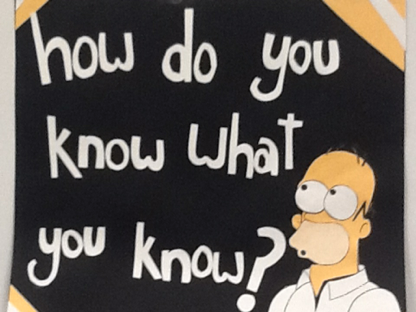
So where does that leave us?  I believe that the questions need to be something different.  As my friend Homer Simpson always asks from a poster in my classroom:

As a US history teacher, I leave it to my students.  I tell them that I'm not worried about agreeing with them, but understanding them.  I also tell them that I'm not going to teach them WHAT to believe, but HOW to understand and explain what they believe.  This is where my friend Homer Simpson comes in.  If they can tell me how they know what they know, then I'm much more likely to understand what they are saying and more importantly, they will be able to understand and explain to themselves what they know and believe.  This is what they can take out of my class beyond the themes and ideas inherent in US history.  They can make arguments about any subject.  They can get a job and qualify for a loan if they can answer this question for themselves.  They have gained power from my US history class.
With that in mind, how do the legislators in Oklahoma who are creating these bills know what they know?  Did they learn it in their high school history classes?  Or, as I hope, did it start in school and then continue out into the real world where history lives everywhere around them?  Isn't this the bigger question that the electorate in every state needs to ask their legislators?  How do you know what you know?
This brings us back to our original question.  Isn't history meant to be a lightning rod?  And shouldn't that bring us back to the more fundamental question of how we know what we know and how we understand and explain what we know?
What do you think?  Learning is my business!

Monday, February 16, 2015

Songs in My Head--Punk Rock and My Teaching--Control, How, Why, and Choice

I spend the vast majority of every day with some song or tune running through my head.  It can greatly shape or describe my mood and overall attitude toward the world at that moment.  These songs are always affecting my teaching.  So to start this series, I lead off with Black Flag's "I've Heard it Before"

I've heard it before
Don't want to hear it again
I've heard it before
Just want to shut you up

F*** all you people can't see my side
Got my own strategies for my life
I've seen the emptiness in your ways
Don't tell me how to make my way


I'll never forget the first time I heard this song!  It was 1982 or 1983.  I was in my friend's bedroom with a few other guys after school and my friend was playing this lousy cassette tape as loud as his tape player would go.
My jaw dropped!  I couldn't believe what I was hearing!  I laughed my head off.  I jumped up off the bed and started jumping around the room and yelling.  I was so happy. "Yeah!  This is great!"
These lyrics had followed a full on intro rant against authority and authority figures over a wailing, discordant guitar, which included my favorite line:
"Don't want your bogus attitudes, I've got enough of my own!"
Wow!  This song was KILLER!  I made a copy of the cassette and played it over and over and over again!  Dude, this is me!  I loved it.
I knew the words and sang them all the time.  I felt them to the core of my being!
"I've Heard it Before" changed how I looked at the world.  My friends and I weren't the only people to think these things!
My teachers or coaches or bosses would go off and tell me to do something without explaining why I should do it or how it mattered and lo and behold Dez Cadena's grinding voice would jump into my mind and I would nod at the authority figure, gnash my teeth and try to figure out if I could NOT DO what they wanted me to do, simply because they were telling me to do something.  Didn't I have a say in this?  Couldn't I decide what was right for me to do?
In another extension of this attitude, my brother and I would act like jerks to my mom.  She'd ask us to do something like take out the trash and we'd invoke the "10 minute rule" which meant we'd do it --in 10 minutes!  It would usually get done, but not until we'd spent 10 minutes doing something OTHER than what she wanted us to do.  That must have aggravated her to no end!
Wow, what a jerk!  Yeah, you're right.  When I was in high school I could be a real jerk and I didn't know why and it's amazing how often I'll see kids now doing the same "stupid" things and I'll just laugh and think back to my lame high school days.  But I was feeling what these songs were talking about and I just didn't realize that I was searching for some kind of control.  Acting like a jerk to my mom and trying to figure out whether or not I really NEEDED to do what my boss told me were ways of trying to make sense of my life and all the forces that were influencing me.
Another great song along these lines is "Institutionalized" by Suicidal Tendencies.  My favorite lines from this song are:

...We decided?
My best interest?
How do you know what my best interest is?
How can you say what my best interest is?
What are you trying to say, I'm crazy?
When I went to your schools?
I went to your churches?
I went to your institutional learning facilities
So how can you say I'm crazy?


I loved that here was great, loud music asking all sorts of questions that I had always wondered about in a very confrontational way.  It was liberating and enlivening at the same time.  It was a breath of fresh air refreshing my juvenile soul.  Whew!
Great, yeah 30 years ago, I was like that, but OK, so how does this affect my teaching?
Whenever, I hear myself telling my students or my players to do something, I make sure I tell them why I want them to do it or how it can help them or their classmates or teammates.  I want them to know WHY I want them to do it and I can explain it to them.  I want to them to know HOW it helps them or their classmates or teammates and I can explain it to them.  I want them to know that I'm asking them to do something that will help them or someone else and they're not doing it just because I said so.
I'll never forget my math class my junior year in high school.  The teacher was really nice and he was very smart, but I just could not understand what he was talking about.  I'd always liked math and I'd always been good at it.  I liked doing it, but this trigonometry stuff was different.  It was the class after lunch and I'd come in after having eaten and I'd try to follow along and I'd get lost and I'd realize that I was tired and I'd put my head down and I'd go to sleep and I flailed my way through that class and learned enough to get a C.  It was the last math class I ever took.  It was a drag.

What a waste of time.  I felt bad about it, but I felt REALLY bad the next year when I took physics and trigonometry BECAME USEFUL!  I couldn't believe it!  Here was the stuff that I'd hated the year before all of the sudden coming to life and making sense.  Wow!  Why didn't you tell me this last year?!?  I didn't know how it was useful or why I was learning it.  If we'd had a class that combined trig and physics, it would have made so much more sense.  Whenever I'm working with a class, I try my best to make sure that everybody can answer why we're doing what we're doing and how it can help them or someone else.  Otherwise why am I teaching them what I'm teaching them?
A great example of how to handle this happened to me once upon a time when I was a young football coach working with a really successful master, George White of Galileo High School in San Francisco and the Hamburg Blue Devils in Germany, he told his son and me never to ask him during a game why he wanted us to do what he was asking us to do.  There was no time during the game to discuss why's and how's, but that he'd be glad to explain to us whatever we wanted to know after the game.  He was true to his word as we peppered him with the why's and how's and he patiently and happily answered them all.  He was a great coach for that and many more reasons.
Punk Rock Football Coach???

Both of these songs also bring up choice, which is another aspect of teaching I deal with all the time.  The voices in both songs are wailing for the lack of control and I believe choice is the key.  In "I've Heard it Before," the voice is railing against authority and saying that authority leaves no choice and just tells us what to do, but not why.  The authority figures keep saying the same things to us but not why they want us to do them or how what we're doing is good for us or anybody else.   Just do what I say.  No why's or how's or a choice at all.  That better not happen in my classroom.
If you want to hear the song, it's linked below, but beware there are
LOTS OF "BAD" WORDS WITH F'S AND BS'S AND LOTS OF ANGST!!!

"Institutionalized" argues that we're just creations of our upbringing and those authority figures are blaming us when they should be blaming themselves for what they and their institutions have created.
Now the tables are turned and I'm the authority figure, the one telling them what to do and I need to let them know that everybody ALWAYS has a choice.  I need to ALWAYS explain why I'm asking them to do what they're doing and I need to ALWAYS explain how what they'll be doing is good for them or someone else and that they can choose in there.
If you want to hear the song, it's linked below, but beware there is
LOTS OF ANGST!!!

I used to teach in continuation schools.  These were the schools for the BAD kids.  These were mostly boys who had gotten in trouble and were on their last educational legs.  If anybody had a choice, THEY had a choice.  For the most part, they had chosen to be there.  Somewhere else they had chosen not to do their school work and now they were with me.
We started with a choice.  I would talk to all of them one on one and explain that they could choose to be there or not and that they could choose to do the work or not.  At first, they'd all explain that they HAD to go to school or many of them would go to jail of get in some other kind of trouble and that they had NO CHOICE.  I'd quickly explain that they DID have a choice of whether or not to go to jail or get in trouble.  If they came to school and did their work they wouldn't get in trouble at school.  It got to the point where I'd tell them that nobody had dragged them by the scruff of the neck to school and that they'd gotten out of bed and out of the house and come to school by their own choosing.  No one had made them come to school.  From their they could choose why and how they did their work, not because I or anybody else made them.  They could choose to do all the work really well and get an A or they could get through with C's or they could choose to do something else and get an F.  For any of those scenarios to happen they had to make choices.  Sooner or later most of them decided to take control and go where they wanted to go.  Some decided to go back to jail and some decided to get a diploma.  Either way, they made a choice.
Black Flag and Suicidal Tendencies helped me learn early on that I needed to know why I was doing what I was doing and how it was going to help me or somebody else.  I also needed to know that I was choosing to do it.  I also learned that many of my students feel the same way and the more I can let them know why and how and help them understand that they have a choice in the matter.  When I think of "I've Heard it Before" and "Institutionalized" when I'm in school this is what I think.
What do you think?  Let me know.
Learning is my business!

Punk Rock Classroom--Learning the Code


Once upon a time I was part of the entertainment.  From the first note of the show, I was in the pit and stayed in and around it and maybe took a break as I worked my way to the front and then leaned on the fence or the stage and watched the real entertainment, the band.  Once I'd caught my breath or the band had cranked up a song that needed my involvement, I headed back into the pit.
Wow, what an exhilarating experience.  Pure energy, super noise, release.  It was so different from my day to day experience.  I could scream myself voiceless, become drenched in sweat, smash into total strangers, and get knocked to the ground all while listening to my favorite bands play my favorite songs.  Was there anything better?
It was sublime, we were violently peaceful, but how?  We knew that we were in this together.  We were a community and we learned the code.  My friend David Theriault turned me on to this video that captures this spirit very well, "Another State of Mind..."

At first glance, the pit is crazy.  People are flailing their elbows and knees, kicking and thrashing.  How is that fun?  How does it work?  How do you know?  What if I fall down?  What about stage dives?  Lots of questions...
On my way to my first show, I was nervous.  I loved the bands and the music, but I didn't know what to do with the show.  Should I slam dance?  Should I go to the stage?  What if I fall down?  What about stage dives?  What if I get in a fight?  How do you know?
We'd had plenty of experience in garages.  My friends were in bands and we'd slammed each other around and it was fun.  But going to a concert with strangers in the big city was different.
OK, the show started and the pit got spinning and I stood on the edge and watched the other kids and did what they did.  When someone came toward me, I pushed them and sometimes they pushed me back.  That was easy enough and it was fun.  As I got more comfortable, I got more aggressive and got more pushy, but then somebody fell down...
Boom! He got picked right up and was pushed forward with the others.  The next thing I knew a friend of mine grabbed me by the front of my shirt and threw me into the pit.  Sink or swim, here we go!  At first I just ran around and bumped into people and then I remembered the music and I started to move to the beat and I got my elbows and knees going and I was slamming with the big kids!
Whew!  What a rush!  Somebody fell done, I picked him up and pushed him forward.  I got knocked down and somebody picked me up.  I just kept moving to the music.  It was great.  By the end of the show, I was completely drained, totally drenched with sweat, and I was overcome with a feeling of total peacefulness and community.  I floated out the door and out into the real world.  There were no hard feelings, plenty of bumps and bruises but no big injuries.  There was a whole different way of doing things, expressing myself and there were lots of other people from all over who were doing it too!
I had learned and I was a different person for the experience.
From then on, I always found my way into the pit as I had learned how to slam and I had learned the code.
How had I learned?  First off, I was with my friends.  They were as inexperienced as I was and they were willing to take the leap.  Second, there was the music that we knew and loved.  At the very least, I would be able to see and listen to my favorite bands.  Finally, I learned by getting in the pit and making my way and I became part of the code.  I was learning as I moved forward and the whole thing became part of me as I became part of it.
What's the takeaway here?  My students enter my classroom with some of these types of questions and reservations and I want them to know that I know this and that the code of the pit is part of the classroom that I strive for.  Sometimes we get it and sometimes we don't.  But in the end, I want my students to know that I will help them get in the pit and their friends and I are all in together.  I want them to know that we'll help them if they fall.  And, finally, when it's working right, they'll pick up their friends and me up when we fall down too.  If we do this right, we'll create a community.
When we leave my class, I want them to realize that there's another way of doing this.  I want them to float off to the next class.  We can create a community if we create and learn and live by a code.
The Punk Rock Classroom, what do you think?  Learning is My Business...

Thursday, August 7, 2014

Notetaking Warrior Learning Style!

"Read pages 1-25 from the text and take notes and turn in tomorrow at the start of class."
This type of "instruction" has been increasingly mocked in the last decade for good reason.  However, many have taken this mocking to mean that we should not read textbooks or take notes anymore.  No, that's not my take on the mocking.  My take is that we need to choose good texts and make sure to give the ourselves a structure to build our own individual understanding of what the text presents.  That's what we will deal with here, the structure that allows our students to build their own understanding of the content presented by a text.
Let's start with a couple of metaphors.  First, the warriors.  We need to become Warrior Learners and practice Warrior Learning.  I like this romanticized version of Uncas from James Fenimore Cooper's The Last of the Mohicans.
Or for the girls in our class, we could go with this:
Either way, we need to transform ourselves into Learning Warriors as we need to approach our learning from an active and ferocious perspective.  We need to think of ourselves as the guardians of our own villages of knowledge.  We need to protect ourselves from ignorance and we need to be the hunters of greater understanding.  We need to change ourselves from passive receptors of facts and figures, (the people of the village who simply exist, the students who merely take notes and turn them in) into those who seek greater mastery and better clarity like the warriors of the village.  If we actively and ferociously learn, we won't ever just, "Read pages 1-25 from the text and take notes and turn in tomorrow at the start of class."
Now that we've remade ourselves as Learning Warriors (and this is an ongoing process that takes some much longer than others), on to the next metaphor.  It's time to eat.  We're going to treat our reading assignment as if we're going to eat a baked potato.  When served, the potato can look something like this:


However, depending on one's tastes, after adding some fixings it can end up looking like this:

Or, it can look like this:
Regardless of one's taste, nobody eats a baked potato as it was served, just plain.  We make it into something really tasty and enjoyable and happily eaten.  That's got to be our attitude toward notetaking, we eat it when we make it ours, we don't just eat what the textbook served us, we eat the information the way it tastes good to us.  We need to transform the information into something that's more palatable and something we can digest better so we can remember it and use it better.  If we can read and take notes in this manner, we will have not only transformed ourselves, but we will have transformed the information.  We will have a deep, individual, and meaningful understanding.  We will have moved up or down a number of intelligences and begun to truly understand for ourselves what it is we are supposed to know.
This won't be easy or simple or always fun, but we will know how we know what we know and we will know why. 
It won't be anywhere near the drama of the opening scene of 300, where the young Spartan boy is cast into a world of violence and made into a killer and is able to fend for himself against the wolves, both metaphorical and literal.
But we will be stronger and more powerful when we have mastered the art of Notetaking Warrior Learning Style!
How do we do this?
We start with a Google Presentation Template like this:


And we take the metaphorical plain baked potato and we make it to our own tastes.  We do this by breaking the chapter into the seven AP US History themes, Identity, America in the World, Work Exchange Technology, Ideas Beliefs Culture, Politics and Power, Environment and Geography, and Peopling.  We need to define and regularly redefine the themes as they evolve in US history.  Just that ability to redefine and track how the themes change throughout the course is a great lesson in historiography, but this will allow us to be able to understand what we are looking for in each chapter. 
We are required to write down the chapter number, title and dates of the chapter in order to make them stop and think why the chapter is titled as it is and to get them into the mode of using the different cues and clues that the texts use to make the words more accessible.
Their first run through the chapter is designed to get the us to understand the breadth (but not the depth) of the chapter and the different ideas that the authors thought were important enough to mention in the title or the section subtitles or to include as a visual as a map a diagram or a photo, painting, or cartoon as this example from Kennedy's The American Pageant shows.  
We don't want to waste our time taking notes that won't matter when the chapter is over, so if we understand the bigger picture, we won't be taking notes on the first sentence or page of the chapter unless they're going to matter when the chapter is finished.
Now that the bigger picture seems clear, the notes can be taken as we take our second pass through the chapter and "read" it as opposed to skimming as we did in the first go through.  With that said we enter the second stage of Notetaking Warrior Learning Style.  Now we need to get into the actual words and see if the information we think is important has any kind of backing in the form of examples and details.  We need to understand the hierarchy of information.  We need to know that ideas are at the broadest and most general level and that examples are more specific and that details are at the most specific level of information.  We are going to take this ladder of information straight into our essays as we introduce ideas and back them with examples and explain the examples with details in the body paragraphs.  Thus, the second slide in the template looks like this:
How do we differentiate between the three different levels?  However it happens is immaterial but we need to KNOW how it happens.  We could start with the ideas like Jacksonian Democracy in 1832 or Colonial Disunity in 1754 or Women's Rights in 1848 and find Andrew Jackson, "Join or Die, or The Seneca Falls Convention as the examples of these big ideas.  Another way is to locate examples and push to find proper nouns.  You know, the words that start with capital letters!  What ideas do these proper nouns illustrate and how do they illustrate them?  How did Andrew Jackson personify Jacksonian Democracy?  How did Franklin's "Join or Die" illustration exemplify colonial disunity in 1754?  How did the Seneca Falls Convention represent the level of women's rights in 1848?


From here we need to find the important details we will use to explain why these ideas were important and how our examples illustrated our big ideas.  Regarding Jackson, we could use the details of his upbringing in backwoods North and South Carolina and his hardscrabble existence and then his movement west to get started as a lawyer and speculator.  For many white men of his time, his life was their inspiration to set out and make a living the west for themselves.  What were the details?  The Wraxhaws, his movement to Nashville, who he worked for and how he earned his living.  The more specific the better.  For "Join or Die" we could use the lack of delegates at Franklin's Albany Congress and their inability to assert themselves against their British "superiors" to explain how disunited the colonists were in 1754 and how Franklin's illustration showed it.  In other words, only seven of the thirteen colonies were present, Franklin published the image in his own newspaper , the Pennsylvania Gazette,  and was used to urge unity against the French and their native allies, NOT against the British.  For Seneca Falls we could use excerpts of the Declaration of Sentiments to show how women had been excluded from many of the rights listed in the Declaration of Independence and how many men were able to take those rights for granted.  For instance, we could use the opening lines, "We hold these truths to be self-evident: that all men and women are created equal."  We could explain that Lucretia Mott had been refused the opportunity to speak at the Wold Slavery Convention in London in 1840 because she was a woman even though she was a full delegate at the convention.This would clarify how many women began to look at their rights and realize that they had a way to go before they were the political equal of men.
This is what one student's notes looked like in the chapters that covered Jackson, "Join or Die," and the Seneca Falls Convention.
Now that we've taken our notes, it's time to put the books away and focus on our notes.  We need to build questions for the information we have gathered.  What question would these notes answer?  With that type of interrogative perspective, we will understand whether we have gathered good information or whether we need to go back redo our notes.  We'll also build an understanding as to what is a good "how and why" question.  We're asked to build three quiz questions that our notes would cover.  In essence we're asked to anticipate what would be a good question that our notes would be able to answer.  From there through the notetaking and quiztaking process, we quickly learn what are good questions, but more importantly, what are good notes.
Let's fast forward to the six weeks leading up to the APUSH test.  Now we've finished the textbook and we're done with the overall historical timeline.  We need to review and solidify what we've learned.  Now we go back and "redo" our notes.
We are asked to pull the themes out of the chapters and put them into thematic Google Presentations.  For The American Pageant, instead of 42 different chapter presentations with about seven slides per chapter, we have seven thematic presentations with about 42 different slides.  Now that we've gone through overall history, we can look at it differently though a distinctly thematic perspective.  We're also asked to make any modifications or adjustments to each slide, add a visual that will illustrate the main point of that slide and create a question that the information on that slide would answer.  Here's how the corresponding slides looked after the review process.

Now as we're preparing for the most rigorous AP test going, we've gone over our notes a number of times and transformed our learning and understanding each time.  If we've fully followed this process, we've not only given ourselves a chance to pass the APUSH test, we've also gained a three dimensional understanding of US history and begun to understand how to view history from our own perspective and how to develop that perspective.
In the end, we have truly taken a somewhat unpalatable offering and made it digestible.  We've transformed the baked potato from dry and bland to exciting and tasty according to our own tastes.  We've also changed ourselves from passive note takers into ferocious, engaged Warrior Learners, who have primed ourselves for success.  We can take massive amounts of information that is completely new and over the course of less than a year make it familiar and useful.
That's our Notetaking Warrior Learning Style!  What do you think?  Let me know.  Learning is my business.

Sunday, July 13, 2014

The Class Blog--Is it ever finished?

After playing with the idea for years, finally, this year, my AP US History and AP Econ and Gov classes are going to produce, build, and write class blogs.
I did like my daughter does, I resisted suggestions to make a class blog until I KNEW EXACTLY how it would work.  (Well, not exactly, but much better than I did before)
Below is a picture of my daughter being thrown through the air into the pool even though she isn't quite ready to dive...  She's quite happy for me to throw her, but she's not quite ready to dive on her own... One of these days she'll be ready to dive and then it will happen.  Until then...

Why did I finally make the leap?  After years of tinkering and playing, I finally saw how our blog could be interwoven into our insanely time-intensive classes and how they would help us consistently answer our most basic questions.  I finally understood how they would work.
Opening Credits from "Run Lola Run"
My driving questions are central to the blog.  How do we get 100% of our students to work together to a common goal that helps all of us somewhat equally?  How can we blend responsibility with freedom of opinion to help us learn better?  How can we learn to think, write, and communicate better?  How can we learn the writing and creative process in a group manner>?How can we learn to see issues, ideas, and attitudes from different perspectives?  And finally, how do we know if "IT" is ever finished?
Opening Credits from "Run Lola Run"
We are going to watch the opening to the 1998 movie, "Run Lola Run" to give the students a visual understanding of the different constraints under which we are going operate, the types of questions we
Opening Credits from Run Lola Run
need to be good with answering, and the pace with which we need to move.  We need to understand that our challenge is daunting, no question, but at the same time, the reward is great if we work together to reach our goal.  I could follow our friend Thomas Paine in "The Crisis":
By each student publicly communicating his/her understandings and allowing him/herself to be critiqued in a positive manner, I hope we can reach our goal of all our students learning and understanding enough of US History and historical thinking to be able to pass the APUSH test in May. Likewise with AP Econ and Government, we need to understand macroeconomic and government concepts and thinking well enough to be able to pass the AP Macro and AP Gov tests next May.
Finally, we will also have a place for civil discourse regarding what we're learning and how we're learning and understanding it.
For years my students have used Google Sites to build their own personal blogs which have worked as a simple place to turn in their work and keep it as a portfolio of sorts.
These have worked very well at streamlining the turn in process and keeping the students' work in one place as well as teaching the students how to manage a personal blog and keep their work organized. However, now we need to go bigger time, now we need to get all our thoughts and ideas together and see where it takes us.
How are we going to do it?  We're going to use Blogger as we're a Google District and we've given all students access to this very flexible and powerful tool.  I've set up a very basic blog for both my APUSH and APEG classes and it's up to them to decorate it in a manner they decide.

 In order to get started, I go into Blogger and click on my Minarets APUSH 2014-15 blog and I get the overview screen.  From there, I click on settings

After that I add my students' emails to add them as authors and then I can decide on how "public" I'd like the blog to be with public as the default.
OK, so what's the assignment, you ask.  Here it is:
When all is said and done at the end of the year, we hope that we'll build a place for all the students to use as their voice as well as a resource for them to reference when they are studying for midterms, finals and the AP test.  We also hope to prove that the sum of the individuals is greater than the whole and that we can learn more together than we can separately.
Finally, the above blog post is something of an experiment from an idea I got from David Theriault's blog, The Readiness is All.  He had his students build presentations from blog posts, which is an idea I would like my students to pursue in order to gain a more multimedia aspect to their blogs.  As you can see, I could keep working on this, which brings us back to one of the main questions, "Is it ever finished?"  Well, I'm going to post this now, which means on one level that it is finished.  However, if you see something you like or don't like, you could comment on this post and thus continue the process.  This idea of ongoing debate or inquiry is a concept I'd like my students to pursue.  On one hand, they have to finish their work and turn it in, but they can continue to debate and question what they are learning in the never ending quest to find out how they know what they know, which is a question we are constantly looking to answer in my classroom as seen below:
What do you think?  Please let me know because as the blog says, "Learning is my Business."